Judge rules ex-VP Howard-Taylor broke her medical-release terms; seized phones and computers stay with the court
Criminal Court 'C' made its Sept. 22 seizure order permanent and warned that another breach could send her back to Monrovia Central Prison. She has not been convicted, and the written ruling has not been published.

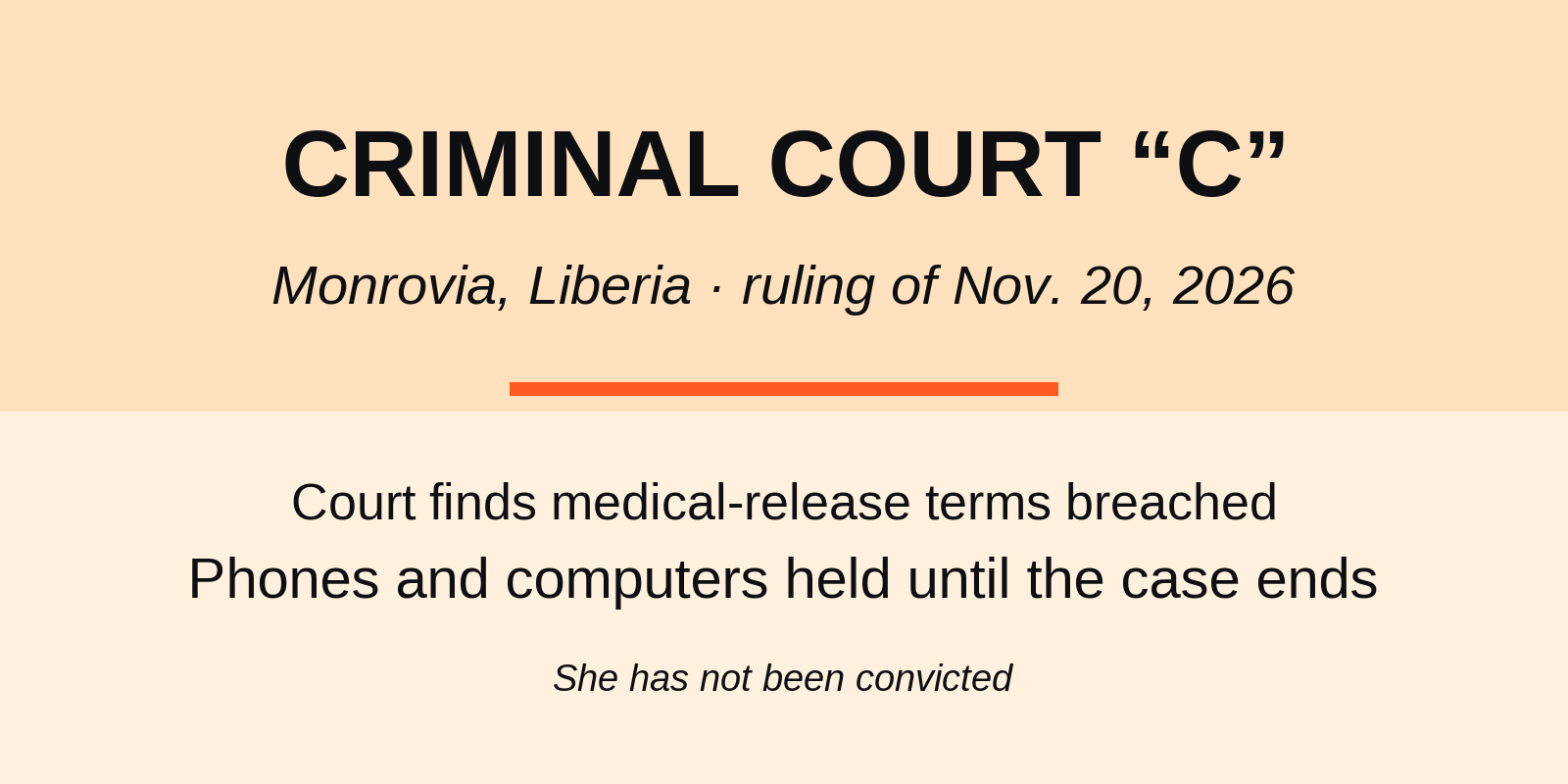
A Liberian judge has found that former Vice President Jewel Howard-Taylor violated the conditions of her compassionate medical release by having communication devices in the home where she is detained, and has ordered those devices kept by the court until the drug case against her is over (The Liberian Investigator; Reports 231).
Judge Ousman F. Feika of Criminal Court “C” ruled on Friday, Nov. 20. He warned that one more breach could cost her the release and return her to Monrovia Central Prison (Reports 231). Leaving prison on medical grounds, he said, “does not amount to acquittal, pardon, immunity or dismissal” of the charges (as quoted by the Investigator).
Howard-Taylor has not been convicted. The charges against her are allegations, and she has denied them (The Liberian Post). The Signal did not find a public response from her lawyers to Friday’s ruling.
What the judge decided
- The ministry’s filing granted: Feika granted the eight-count bill of information the Ministry of Justice filed on Sept. 22, threw out Howard-Taylor’s resistance to it, and turned that day’s interim order into a permanent one (Investigator).
- The devices stay seized: the sheriff keeps what was taken from the house until the criminal case ends (Reports 231).
- Paperwork for the court: she must give the clerk contact details for the relative who acts as her caregiver and for her attending physician, plus a full medical report for Sept. 4 to Nov. 20 (Investigator).
- Rules on file: the ministry must lodge the security and visitation rules for her home detention, covering visiting days and hours, phones and other devices, hospital visits and exercise (Investigator).
- A rebuke: the judge called her account of how the sheriff enforced the Sept. 22 order “grossly contemptuous” and told her not to repeat it (Investigator; Reports 231).
What was seized? The outlets differ
Unverified / Developing: The two reports describe the devices differently. The Investigator says the judge found she kept “a phone, a laptop and a computer”. Reports 231 lists what the sheriff took after the interim order: “a Tecno phone, a landline telephone, an HP laptop, an iMac computer, a printer and other computer accessories.” Both say the ministry first told the court that officers on a security inspection found two mobile phones it said were hers. The Signal has not seen the written ruling, which has not been published, so we describe the items generally as phones and computer equipment.
The arguments
The ministry alleged she used the phones to contact people outside, among them people it called persons of interest in the case, and said that could damage the prosecution (Investigator). Her lawyers answered that detainees at the central prison have phones and televisions, so she should be treated the same, and that the search needed a proper warrant, citing the Supreme Court case Cee Netty-Blanquett v. Government of Liberia (Investigator).
Both arguments failed. The judge’s reasoning, as both outlets report it: the Sept. 4 release order made her home a detention facility, so prison-style security rules apply there.
How she came to be at home
On Sept. 4 the same court moved her from prison to guarded home detention on medical grounds. The government prosecuting her had itself asked for that relief (The Liberian Investigator, Sept. 4). The conditions included round-the-clock police security, handing her travel documents to the sheriff, a single family caregiver, and leaving the house only by court order or for approved medical visits. The court also said she could go back to prison if doctors found her health had improved appreciably (Investigator, Sept. 4; The Liberian Post).
She is being prosecuted alongside Teras Zadereiko (also known as Mihovil Vrovac or Michael), Nikola Ivancic and others not yet named. The charges include drug importation and trafficking offences, money laundering, abuse of office, criminal conspiracy and criminal solicitation (Investigator; Reports 231). For background on her August arrest, see our story on the Weah arrest-plot claims.
What to watch
Whether the ministry’s security and visitation rules are filed and made public, whether the defense challenges the ruling, and the next hearing date in the drug case. The Signal will update this story when the written ruling is available.
More from Liberia
All Liberia →
From The Signal
Liberia and Africa's top stories, fact-checked, free
When a new briefing is ready
All regular topics by default; Breaking alerts are optional. Confirm by email, then change your picks anytime. Choose topics first. No spam. Unsubscribe anytime.