Young people in 20+ European countries march over living costs and military spending
The Youth Strike coalition said rallies were planned in about 400 cities. No one has published an overall turnout figure.

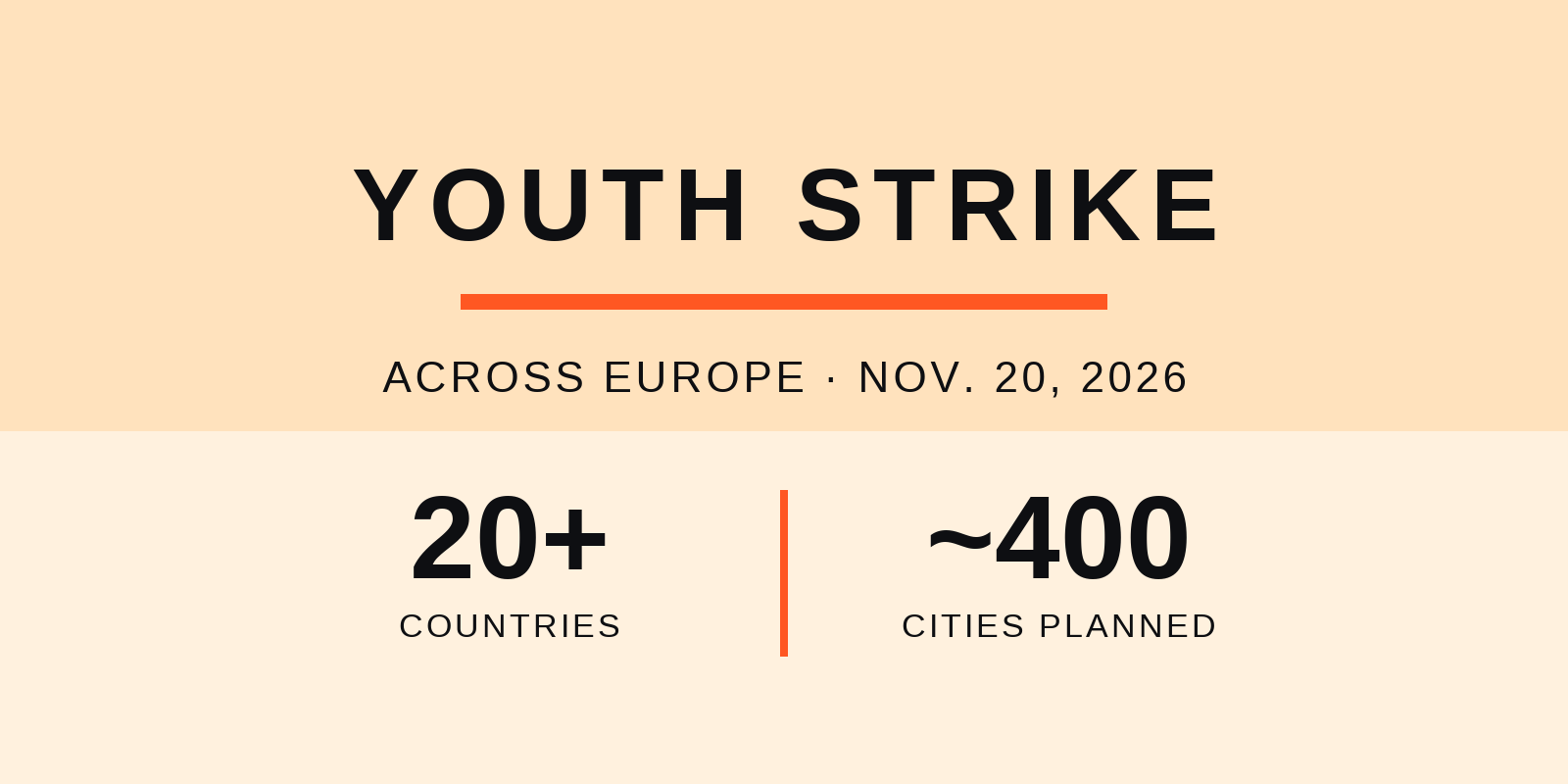
Students and young workers took to the streets on Friday in more than 20 European countries, protesting the cost of living and housing, worsening conditions in classrooms and lecture halls, and governments’ growing defence budgets, The Guardian and ABC News of Australia report.
The day was called by the Youth Strike coalition, an alliance of more than 50 groups. It described the action as the continent’s largest coordinated youth protest in recent years and said marches were planned in roughly 400 cities, under the slogan “fight for our future, not their wars” (Guardian). The countries named by the two outlets include Italy, Germany, France, Spain, Britain, Belgium, Greece, Portugal and Croatia. Neither the organisers nor the police had published a total turnout figure by Friday evening.
Five demands
According to the Guardian, the coalition put forward five broad demands: an end to militarisation and conscription; steady public money for schools, universities and welfare; climate and social justice; solidarity with Palestine; and a “radical transformation of the system we live in”.
City by city
- Italy: Tens of thousands marched in Rome, Milan and other cities on a day when the CGIL, Italy’s biggest trade union, held a general strike against Prime Minister Giorgia Meloni’s economic policies (Guardian, drawing on AFP and Reuters). In Rome, ABC said, riot police waited as marchers passed the Colosseum on the way to the education ministry. A small masked group threw firecrackers and other objects, but the march was otherwise largely calm.
- Germany: The Guardian put the Berlin crowd at about 1,000 students, driven by fears that compulsory military service could come back. ABC described the Berlin “Gen Z regelt” (Gen Z takes charge) march as one of the biggest of the day, with thousands taking part. The two outlets’ figures differ.
- France: The gilets jaunes (yellow vests) movement, behind the 2018 and 2019 protests, was among the organisers (Guardian). ABC said the Paris march was quieter than the recent school protests, and that bigger rallies were expected over the weekend.
- United Kingdom: Outside Parliament in London, marchers faced a rival right-wing group, and police kept the two apart (ABC). One banner read: “No to war, racism, climate crisis, capitalism” (Guardian).
- Spain: The protests coincided with the anniversary of the death of the dictator Francisco Franco (Guardian).
What they said
“We are living under a government that is cutting healthcare and education, taking away our present and trying to rob us of our future,” Laura Peritore, a 24-year-old university student, said in the Guardian’s report. “We will not back down and will take our future back.” Shabbir Lakha of the UK-based Stop the War coalition called the day “a crucial step towards building a lasting international movement capable of bringing together young people, students and workers around common demands” (Guardian).
Why now
The Guardian traces the wave to weeks of protest that began with long-running school protests in France and spread, as governments struggle with demands for affordable homes, working public services and fairer societies. ABC notes that major European elections are due in the new year, and that leaders are weighing calls for lower defence spending against security worries driven by Russia’s full-scale invasion of Ukraine.
What’s next
Organisers told ABC the marches are the opening of a campaign, not a one-off.
More from Europe
All Europe →- Photo: Oxyman, CC BY 2.5
- Illustration: The Signal
- Photo: © European Union, 2025, EC Audiovisual Service
From The Signal
Liberia and Africa's top stories, fact-checked, free
When a new briefing is ready
All regular topics by default; Breaking alerts are optional. Confirm by email, then change your picks anytime. Choose topics first. No spam. Unsubscribe anytime.