300,000 applied, 13,309 graduated: Ghana's apprenticeship programme turns out its first class
President Mahama promised graduates startup capital and links to employers. Those are pledges; no job or funding numbers have been published yet.

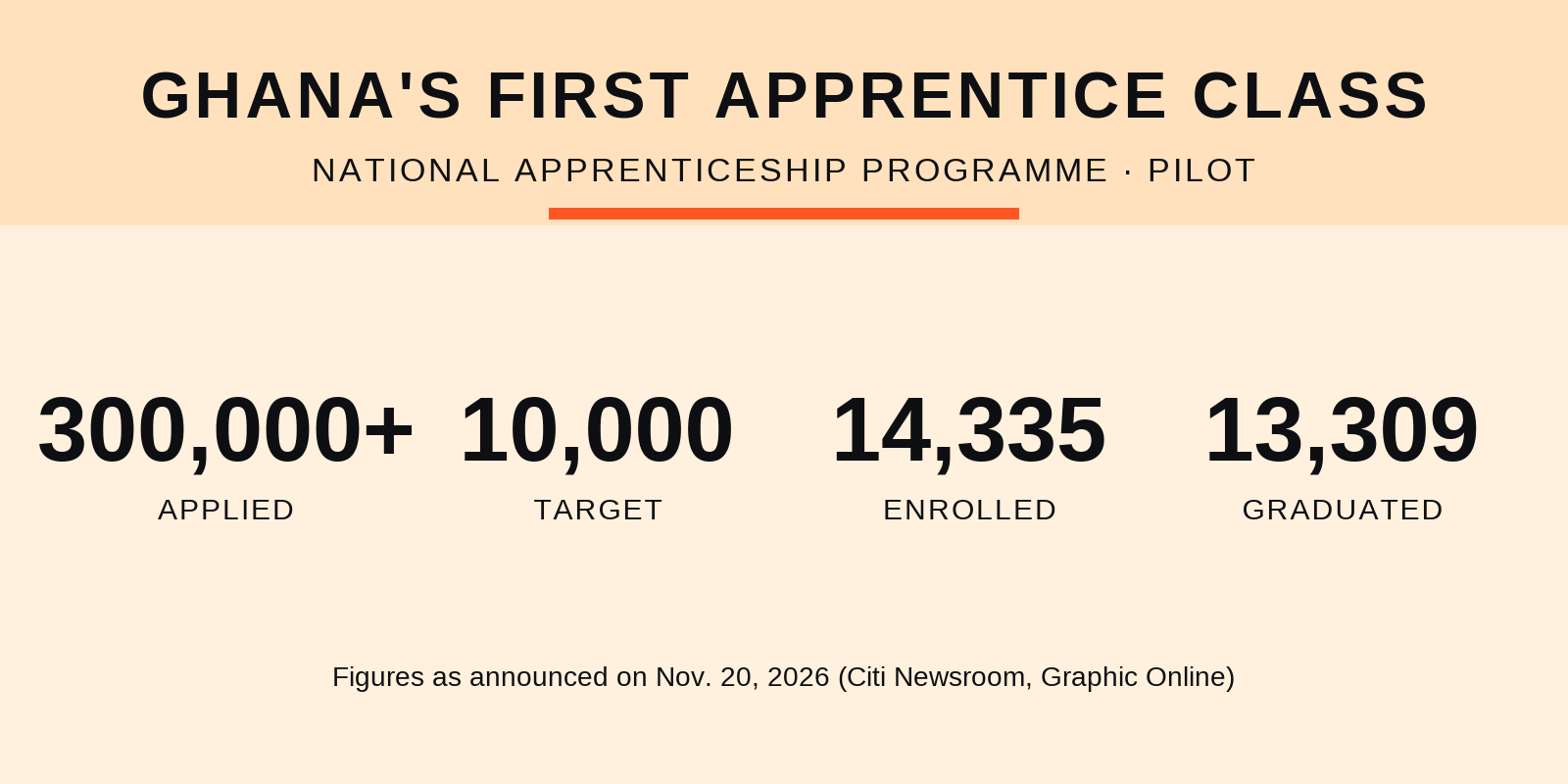
Ghana’s National Apprenticeship Programme graduated its first class on Friday: 13,309 young people who finished training in the pilot phase, President John Dramani Mahama told a ceremony in Accra, according to Citi Newsroom and Graphic Online.
The numbers show how much demand there was. The government planned to train 10,000 people, but more than 300,000 applied. It ended up enrolling 14,335, or 43% over target, and 13,309 of them completed the course (Citi; Graphic). JoyNews has a video report from the ceremony.
“Today belongs to the 13,309 young men and women who make up our first graduating class of the National Apprenticeship Programme,” Mahama said, as quoted by Citi.
Who trained, and in what
Apprentices came from all 16 of Ghana’s regions. Graphic lists five trade groups: fashion and textiles; beauty and personal care; crafts and artisan work; hospitality and tourism; and farming and agro-processing.
Upper West had the biggest cohort, with more than 2,200 graduates, followed by the Northern Region at more than 1,900. Ashanti and Greater Accra each topped 1,400, while Eastern and Upper East each passed 1,000 (Graphic; Citi). Mahama said the regional spread was intentional, to give young people across the country an equal shot (Graphic).
He also urged women to move into technical trades usually dominated by men. “Every profession, what a male can do, a female can do even better,” he said (Graphic).
What was promised, and what is still a pledge
Mahama laid out several routes from training to income, according to The Vaultz News:
- Startup capital through the Adwumawura programme for graduates who want to run their own businesses.
- Hiring links with firms signed up to Ghana’s 24-Hour Economy programme. He said he would ask the 24-Hour Economy Authority to encourage those firms to give graduates priority, using a database of trained apprentices.
- Openings in the New Economy programme, which Vaultz describes as a planned US$10 billion, four-year investment in sectors including hospitality, tourism, textiles and agro-processing.
- A NAP Connect app that would let officials search graduates by trade. “[I]f they need welders somewhere, we can just go in, look at those who did the welding module, and send your names to whoever wants to employ you,” he said (Vaultz).
All of these are commitments, not results. Neither the government nor the outlets have published how many graduates have found work or received funding so far. Mahama himself said the programme should be judged by jobs, business growth and lasting income (Vaultz).
According to Graphic, Ghana aims to put a minimum of 50,000 apprentices through training in 2027, paid for in part by GH¢1 billion raised by uncapping the Communication Service Tax.
A note for Liberian readers
Liberia’s FY2027 draft budget, now before the Legislature, also lists youth skills spending: expanding technical and vocational education and training (TVET), the National Cadet and Internship Program, and livelihood training for at-risk and out-of-school young people, according to the government’s budget summary published by the Liberian Observer.
More from Ghana
All Ghana →- Illustration: The Signal
- Photo: MyJoyOnline / Joy Sports
- Photo: Bank of Ghana



From The Signal
Liberia and Africa's top stories, fact-checked, free
When a new briefing is ready
All regular topics by default; Breaking alerts are optional. Confirm by email, then change your picks anytime. Choose topics first. No spam. Unsubscribe anytime.